

In Part 1 of this series (“The Signal Was There—Did Operations See It in Time?”), we established what experienced operators already know: facilities rarely fail without warning. The breadcrumbs are almost always there—an overnight emissions shift, a process variable drifting just enough to matter, or a corrosion rate that quietly changes slope.
The Detection-to-Action Gap
The real performance divider is the time—and organizational distance—between “something is changing” and “someone intervened effectively.”
- When the gap is quickly addressed, issues stay contained and are handled as routine work orders.
- When the gap is left unaddressed, it increases the risk of unplanned downtime, environmental exposure, and rushed, high‑pressure decisions.
In Part 2, we show how AIoT (Artificial Intelligence of Things) is narrowing that divide—not simply as a technology trend but as an operating model that enables organizations to act sooner, with operational contextual insight, and dependable follow-through.
"A millimeter-scale leak addressed early is a routine work order. Addressed late, it's an emergency response, hazardous exposure, and severe unplanned downtime. Same leak. Radically different outcome. The only variable? Time."
What AIoT Actually Means
AIoT brings together connected sensors, AI, machine learning, and automated workflows to transform and operationalize raw data into actionable, decision‑ready insight.
- IoT increases visibility — continuous capture of data on asset vital signs (VOCs, temperature, wall thickness, vibration), 24/7/365.
- AI/ML increases interpretability — learning what “normal” looks like, separating noise from real degradation, and adding context that shapes risk.
Automated workflows ensure the insight becomes owned, executed, and verified work.
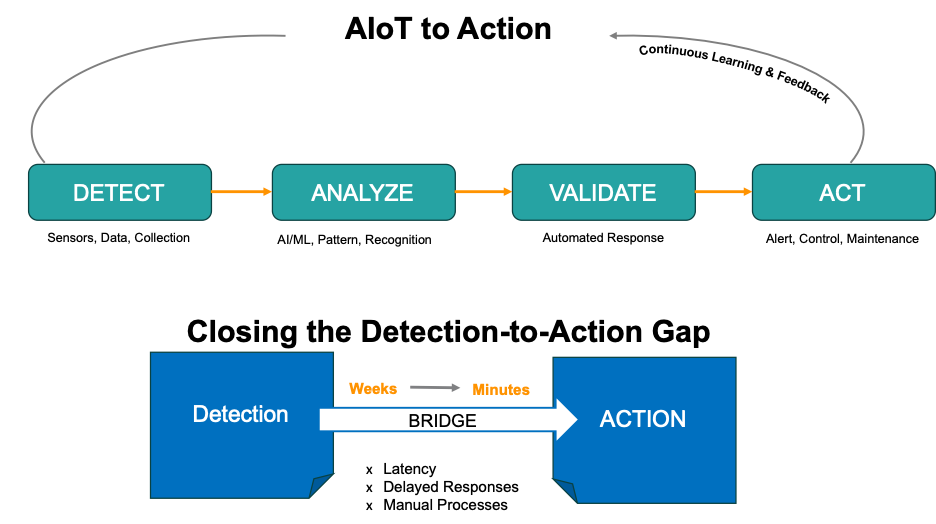
When implemented well, AIoT doesn't just move data faster. It moves decisions faster. According to an IDC InfoBrief, 54% of respondents anticipate major cost savings from AIoT, 52% predict faster innovation, and 63% believe it will boost productivity and competitiveness.
At mPACT2WO, we see a deeper imperative: AIoT transforms passive data collection into a proactive asset and operations strategy. Not a luxury, but a lifeline.
Why Traditional Monitoring Misses Early-Stage Problems
Industrial sites don't lack data. They lack decision‑grade insights at the moment it's needed. Two failure modes recur:
- Threshold‑based alarms trigger late.
- Failure modes often develop long before fixed limits are crossed. To avoid nuisance alarms, thresholds are set wide—so subtle emissions drift and accelerating corrosion are treated as background noise until it’s too late.
- Calendar‑based checks miss what happens between snapshots.
- If a process variable shifts right after an inspection, it remains unobserved until the next visit. Teams then spend hours reconstructing the story rather than executing the low‑cost response that was available days earlier.
How AIoT Extracts the Signal from the Noise
The counterintuitive truth: the greatest barrier to fast action isn't a lack of alerts — it's too many of them. Alarm fatigue is a rational human response to irrational system design. AIoT addresses the alarm nuisance by processing data through a contextual lens so “silence” becomes trustworthy again.
- Dynamic baselines replace static limits. AI/ML models learn an asset's normal behavioral signature and flag abnormal patterns even if the absolute value is within "safe" limits. The number looks fine. The trajectory doesn't. Static alarms will never catch that.
- Context-aware filtering eliminates false positives. AIoT cross-references sensor data with operating mode, ambient conditions, and throughput—grounded in the first-principles of physics and chemistry that govern how assets actually behave. Alerts fire only when deviations are truly anomalous, not when conditions simply shift. Fewer alerts lead to higher trust and faster action.
- Cross-sensor validation confirms weak signals. By correlating subtle emissions or corrosion shift with a localized temperature increase and historical inspection records, AIoT validates what any single sensor alone couldn't prove. One witness might be unreliable. Three witnesses telling the same story? That's evidence.
From Dashboards to Decision Prompts
Dashboards assume someone is looking at the right screen, at the right time, with the right mental model. That’s a lot of assumptions—especially at 2 a.m.
AIoT systems should push structured decision prompts directly to the responsible person, carrying their own interpretation:
- What changed — specific signal, magnitude, verified trend.
- Where — exact asset, zone, and location confidence.
- So what — risk framing: emissions impact, corrosion acceleration, safety consequences.
- What next — recommended verification steps and response pathway.
This isn’t adding more noise. It’s a consistent interpretation across crew shifts and personnel experience levels—so junior and veteran technicians reach the same quality of decision.
Two Scenarios: What "Closing the Gap" Looks Like
Scenario 1: Overnight VOC Anomaly on a Remote Station. An intermittent release occurs off-hours, masked by shifting winds. Traditional threshold alarms don't trip. Nobody sees it until morning—if at all. With AIoT, the system cross-validates sensor data with wind vectors and ambient conditions, localizes the source, and routes a prompt to a responder who isolates a small leak before it escalates. Total exposure: minutes, not hours. Cost? A work order, not an incident report.
Scenario 2: Corrosion Decisions Driven by Trends, Not Snapshots. A periodic ultrasonic reading looks concerning—but is it real degradation or sensor variability? With continuous monitoring, AIoT models smooth out noise and reveal whether corrosion is stable, accelerating, or episodic—giving reliability teams confidence to act on true asset behavior, not snapshot anxiety.
The "Last Mile": Turning Insight into Executed Work
Here’s where many AIoT implementations actually fail: detection without execution is just observation with extra steps.
- Establish ownership — not a team, not a distribution list: a person.
- Change the mindset — from fixing “broken” to addressing the “emerging problem.”
- Configure escalation pathways — automate what happens when the primary responder doesn’t act. Hope is not an escalation strategy.
- Enable closed-loop verification via mobile workflows — on-asset confirmation before an alert is marked resolved.
Data Isn't the Problem. The Gap Is.
Industrial sites don't lack data. They're drowning in it. The gap opens when signals are subtle, context is missing, or alerts aren't trusted enough to act on. AIoT closes that gap completely—continuous observation flowing into noise filtering, contextual interpretation, trusted insight, timely decisions, and verified responses. No broken links. No handoff gaps. No "the data was there but nobody saw it" post-mortems.
This is where early anomaly detection and operational predictability converge. Early detection adds the one asset no technology can manufacture after the fact: time. Operational predictability then leverages that ‘time’ into consistent, confident, proactive decision-making across every shift and every experience level.
Operationalize the complete chain—from the earliest behavioral signal through contextual interpretation to an owned, executed, and verified resolution. Every anomaly detected becomes routine work resolved—never an emergency explained. At mPACT2WO, we help organizations build exactly this paradigm shift—seeing through the noise so your teams can be notified, decide, and intervene when the cost and risk of action are at their absolute lowest.
Because the best time to fix a problem is when it's still small, still quiet, and still cheap.
AIoT to Action starts with one conversation. Turn signals into owned, executed work—faster. [Contact us]